When My Sore Throat Taught Me About Magical Thinking (And Why Your Beliefs Deserve Better)
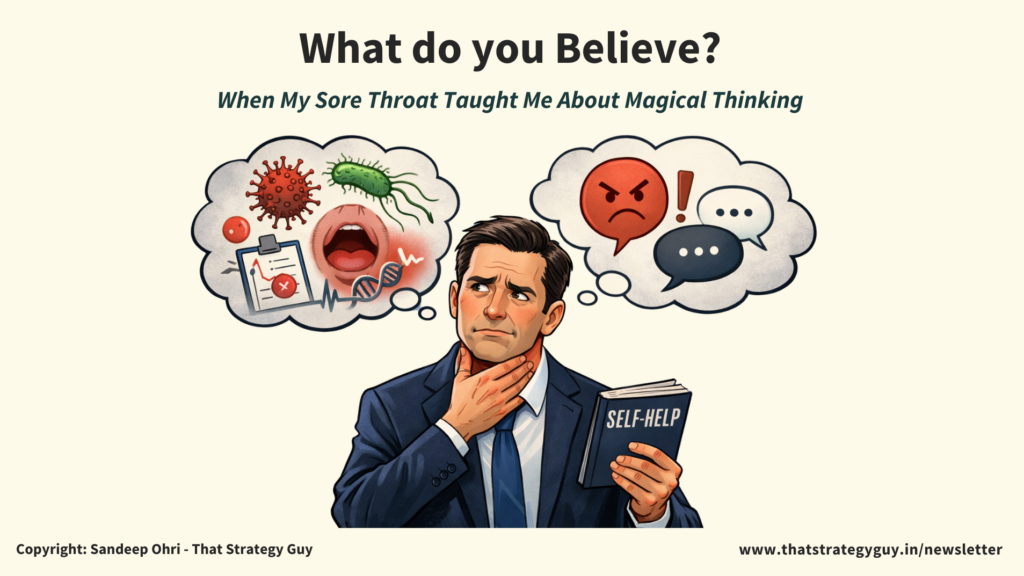
Last week, I woke up with a sore throat. Nothing dramatic, just that scratchy feeling that makes you sound like you’ve been chain-smoking cigars and gargling gravel.
At one point, I resembled a confused blend of Sean Connery, Raza Murad, and Om Puri.
Being the data-driven strategist I claim to be, I did what any rational person would do: I went online…!!!
One site tried to convince me I had three different types of cancer. But then I stumbled across something else, Louise Hay and her book You Can Heal Your Life, which attributes sore throats to “holding in angry words” and “feeling unable to express oneself.”
And I thought, Hmm… that’s interesting.
I actually had been biting my tongue about something. There was a piece of feedback I’d been sitting on, not wanting to ruffle feathers. So, I went ahead and said that thing to that person. Got it off my chest. Frankly, I felt good about being honest.
My throat still bloody hurt!!
But here’s where it gets fascinating.
My brain immediately began searching for another suppressed truth. “Well, maybe it’s not that thing I said. Maybe there’s something else I’m holding back… from someone else! Something deeper.”
Classic confirmation bias gymnastics!
If the sore throat persists, it’s never the THEORY that’s wrong, it’s YOU. You must be suppressing something unconscious, something you haven’t identified yet.
That’s when I put on my That Strategy Guy hat (metaphorically… I don’t actually have a hat, though that would be quite the branding move) and realised: I’d just experienced a masterclass in how simple causation narratives hijack our reasoning.
And that got me thinking about something bigger.
We’re All Walking Around With Unexamined Beliefs
Most of us have built elaborate belief systems we’ve never stress-tested, or thought-through.
We believe things about:
- How money works (“Savings create wealth.”)
- How relationships function (“If they loved me, they’d just know.”)
- How careers progress (“Hard work always gets rewarded.”)
- How health operates (“Positive thinking cures illness.”)
Some beliefs serve us. Many don’t.
But we rarely ask:
- How did I come to believe this?
- And is it actually true?
We’re not born believing Louise Hay’s psychosomatic illness charts or, for that matter, Rhonda Byrne’s The Secret.
We’re not born equating 80-hour weeks with success, or vulnerability with weakness, or productivity with self-worth.
These beliefs are constructed, built up through a messy combination of:
- Things we were told as children
- Experiences we’ve had (and how we interpreted them)
- Stories we absorbed from culture, media, and the people around us
- Cognitive shortcuts our brains made to simplify a complex world
- Marketing messages we’ve internalised without realising it
The problem? Most of us treat our beliefs like heirlooms we’ve inherited.
We don’t examine them.
We don’t question them.
We just… carry them around.
Why Simple Explanations Feel So Damn Good
Here’s why the sore throat theory felt so… seductive.
It offered simple causation in a complex, uncertain world.
Medical reality:
“Viral pharyngitis, bacterial infection, reflux, allergies, dry air, immune fluctuation. We’d need tests.”
Louise Hay:
“You’re holding in angry words.”
One explanation is probabilistic and nuanced.
The other is neat, emotionally satisfying, and actionable.
And our brains prefer… neat!
They feel tidy. Controllable. Actionable.
Ergo…
- Cancer = deep resentment. Solution: forgive and release
- Poverty = negative thinking. Solution: positive affirmations
- Back pain = lack of financial support. Solution: abundance mindset
See how neat that is? Every problem has an emotional cause and a thought-based solution.
- No messy biology.
- No structural inequalities.
- No randomness, or bad luck.
Behavioural scientists have a fancy term for this: ‘the illusion of explanatory depth’, which is just a posh way of saying… we think we understand something because we can generate a plausible-sounding story about it, even when that story has ZERO empirical backing.
And here’s the real trap: when these frameworks fail, they blame you!
- You didn’t release deeply enough
- You didn’t believe hard enough.
- You didn’t manifest correctly.
So, the THEORY can never be wrong… only YOU can be wrong.
The Theory survives. Your self-esteem doesn’t.
That’s not empowerment. That’s insulation against scrutiny!
The 50 Million Copy Question
Now you might say, “Come on, Sandeep, if these books sold millions of copies, surely there must be something to it?”
Fair question.
Let me answer with another question: Do you believe McDonald’s makes the world’s best food because they’ve served billions?
Popularity is a SIGNAL, it is not EVIDENCE!
Comfort is not the same as truth.
These books sell because they’re psychologically comforting, not because they’re scientifically accurate.
Here’s what they offer:
- Simple explanations in a complex world
- Illusion of control (“You caused this, so you can fix it”)
- Low barrier to entry (just think differently!)
- Built-in excuse for failure (you didn’t believe hard enough)
- Massive social proof cascade (if millions believe it, it must be true)
And look, I understand the appeal. When you’re facing illness, financial stress, or relationship problems, the idea that you can THINK your way to wellness or manifest abundance is deeply appealing. It feels… empowering.
But magical thinking has opportunity costs.
- If you believe financial success comes from manifestation rather than skill acquisition, you’re not investing in capability.
- If you believe illness is purely emotional, you might delay proper treatment.
And opportunity cost, as we both know, compounds.
Beliefs compound too.
Choose poorly, and you compound error.
Choose wisely, and you compound advantage.
What Science Actually Says (And Doesn’t!)
Now, before the “closed-minded” brigade arrives, let’s be clear:
Mind-body connections… are REAL!
What’s real:
- Chronic stress affects immune function.
- Psychological factors influence symptom perception.
- CBT and mindfulness improve outcomes.
- Goal-setting and visualisation improve performance.
What’s NOT real:
- Specific negative thoughts cause specific diseases – haven’t come across any controlled studies that support this
- You can cure serious illnesses through affirmations alone – which is downright medically irresponsible!
- The universe rearranges matter based on your thoughts – I’m not so sure that’s how “quantum physics” works
- Poverty is caused by “negative thinking” – really now, are we going to blame poverty on thoughts rather than structural factors?
The difference is EVIDENCE versus NARRATIVE.
The first set of bullet points are evidence-based psychosomatic medicine.
The next set are pseudoscience that misappropriates scientific terminology to “sound credible.”
A Framework for Auditing Your Beliefs
Here’s what I propose: treat your beliefs like an investment portfolio and rebalance them periodically.
Not all beliefs are created equal.
- Some empower you.
- Some paralyse you.
- Some were useful once but are now holding you back.
Here’s my framework for examining any belief:
- The Evidence Test
Beyond your personal experience, what’s the actual evidence?
Testimonials aren’t evidence. Anecdotes aren’t data. “It worked for me” is subject to confirmation bias, post-hoc reasoning, and over at least a dozen other cognitive distortions.
Ask: What do controlled studies show? What do domain experts say? What’s the quality of evidence?
- The Falsifiability Test
Could this belief be proven wrong? If not, it’s useless.
If a belief can never be disproven, if every failure is just “you didn’t do it right”, then it’s not a useful framework. It’s a psychological TRAP.
Good beliefs can be tested and potentially rejected.
Bad beliefs insulate themselves from scrutiny.
- The Opportunity Cost Test
What am I NOT doing because I believe this?
If you believe success comes from manifestation rather than skill-building, you’re probably not investing in professional development.
If you believe illness is purely emotional, you’re probably delaying proper medical treatment.
What actions is this belief preventing? That’s often more important than what actions it’s encouraging.
- The Action Test
Does this belief lead to constructive action or just rumination?
Useful beliefs drive behaviour. “I need to learn Python to be more marketable” leads to action.
“I need to manifest abundance” leads to… what, exactly? Sitting quietly and thinking really hard about money? Seriously??
- The Alternative Explanations Test
What else could explain this outcome?
I said the difficult thing AND my throat still hurt.
Alternative explanations:
- I had a viral infection (Occam’s Razor, or the Law of Parsimony, suggests this)
- The two events were coincidental (correlation is NOT causation)
- The relief from speaking up reduced my stress perception slightly, but DIDN’T affect the physical inflammation
All more plausible than “my suppressed words were creating throat inflammation.”
The Invitation (Not the Conclusion)
Look, I’m NOT here to tell YOU what to believe – I’m not the belief police!
But I am suggesting you AUDIT your “Belief Portfolio” the same way you’d audit financial investments or business strategy.
Ask yourself:
- Which beliefs are serving me?
- Which are outdated mental models I inherited and never questioned?
- Which feel good but lead nowhere?
- Which are preventing me from taking effective action?
And here’s the thing… this framework doesn’t just apply to woo-woo (mumbo jumbo) stuff like manifestation and affirmations.
Apply it to your beliefs about:
- How business development works
- What makes relationships succeed
- How you should spend your time
- What determines career success
- How the economy functions
Some of those beliefs will hold up to scrutiny. Others won’t.
The goal isn’t cynicism.
It’s clarity.
Because here’s what I know for certain: beliefs DO have consequences.
Beliefs shape effort, interpretation, resilience, and resource allocation.
They shape what you attempt, what you avoid, how you interpret setbacks, and where you invest your finite resources.
That’s why you owe it to yourself to choose them carefully.
They’re just too powerful to leave… unexamined.
Well, now you know it too!
P.S. My throat DID get better in about five days. Viral infection, it turns out, that ran its course, exactly like throats have been doing for centuries, long before any self-help book discovered inflammation had feelings.
P.P.S. I’m still working on examining my OTHER beliefs though. Turns out I have quite a few that don’t hold up to scrutiny either. More on that another time.
Select References
- Benson, H. (2000). The Relaxation Response: 25th Anniversary Edition. HarperCollins.
- Engel, G. L. (1977). The need for a new medical model: A challenge for biomedicine. Science, 196(4286), 129-136.
- Locke, E. A., & Latham, G. P. (2002). Building a practically useful theory of goal setting and task motivation: A 35-year odyssey. American Psychologist, 57(9), 705-717.
- Novack, D. H., Cameron, O., Epel, E., Ader, R., Waldstein, S. R., Levenstein, S., … & Wainer, A. R. (2007). Psychosomatic medicine: The scientific foundation of the biopsychosocial model. Academic Psychiatry, 31(5), 388-401.
- Patel, J., Patel, P., & Vaghela, H. (2022). Psychosomatics: Exploring the role of the mind-body connection in causing physical illnesses. Journal of Psychophysiology Practice and Research, 1(1), 1-6.
- Randall, L. (2008). Warped Passages: Unraveling the Mysteries of the Universe’s Hidden Dimensions. Harper Perennial. [On quantum physics misappropriation in popular culture]
On The Secret, specifically:
- Byrne, R. (2006). The Secret. Atria Books/Beyond Words.
- Radford, B. (2007). The pseudoscience of The Secret. Live Science. https://www.livescience.com/5303-pseudoscience-secret.html
On Louise Hay, specifically:
- Hay, L. (1984). You Can Heal Your Life. Hay House.
- Wikipedia contributors. (2025). You Can Heal Your Life. Wikipedia. [Note: “The theories described in this book have been criticized as groundless by proponents of evidence-based medicine.”]
