The Most Useful Emotion You’re Doing Wrong
Let me ask you something uncomfortable.
What’s the one decision from your past that still makes you wince? The one that pops up uninvited at 2 am, settles in next to you, and whispers, “Remember me?”
That, my friend, is regret.
And most of us treat it like a bad smell – something to walk away from as quickly as possible.
Big mistake!
First, Let’s Sort Our Regrets
Not all regret is created equal.
I’ve been thinking about this, and I believe we experience regret in four distinct situations.
Think of it as a simple 2×2 grid:
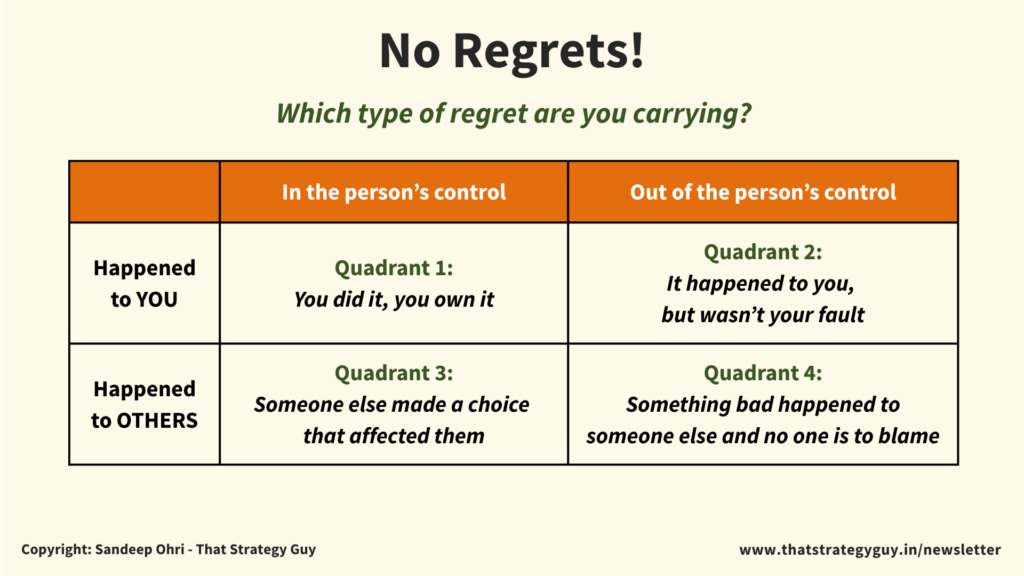
Now here’s the interesting part – we feel these four types of regret very differently, and we react to them even more differently.
- Quadrant 1 (you did it, you own it): This is the heaviest one. “I should have known better.” Full ownership. Full sting.
- Quadrant 2 (happened to you, but wasn’t your fault): Think a missed flight because of traffic. You’re upset, but there’s a ceiling to the self-blame. You eventually say, “What could I do?”
- Quadrant 3 (someone else made a choice that affected them): You watch a friend turn down a good opportunity and you think, “I’d never have done that.” You feel something – call it vicarious regret, or perhaps just mild smugness dressed up as concern.
- Quadrant 4 (something bad happened to someone else and no one is to blame): You feel sympathy, not regret. There’s nothing to rewind here.
The reason these four feel different is simple: the closer the control is to you, the deeper the regret cuts.
Why Humans Can Feel Regret at All
Here’s where it gets fascinating.
In his book The Power of Regret (2022), Daniel Pink points out that humans can experience regret because of two rather remarkable abilities.
- First, we can mentally time travel. We can place ourselves back in a past moment or project ourselves into an imagined future – something most other creatures simply cannot do.
- Second, we can tell ourselves non-factual stories. We can imagine a version of events that never happened: “What if I’d taken that job? What if I’d said yes?” Psychologists call these counterfactuals. Pink’s point is that without this storytelling ability, regret wouldn’t exist.
Think about that for a moment. The very thing that makes us feel terrible at 2am – that mental time machine and our love of fiction – is also what makes us uniquely human.
Pink also notes, citing research, that children below the age of five cannot experience regret. Not because their lives are simpler (though they are – their biggest regret is probably a biscuit they didn’t get). It’s because they haven’t yet developed the cognitive ability to imagine how things could have gone differently.
Lucky them!
I Know This One Personally
I spent years in Quadrant 2 without realising it had a name.
Growing up, there was an unwritten rule in Indian families – if one sibling went abroad, the younger one usually followed. My brother headed to the US for his Master’s in Computer Science. I enrolled in M.Com, partly for the qualification, and partly to buy myself time while I waited for my father to agree to send me abroad too.
He didn’t.
“One son abroad is enough,” he said. “The business needs someone who understands finance.”
I joined the family business – a small packaging operation in Mumbai – with a CA degree, an M.Com, and absolutely no idea what I was supposed to do there.
Within weeks I felt completely useless.
My friends were building careers at audit firms and multinationals. I was sitting in a small office in an industrial area, watching the clock.
For years, I replayed that moment… What if he’d said yes? Would I be in Silicon Valley right now?
What I eventually understood – much later, and somewhat reluctantly – was that my father’s decision gave me something no MBA could: a 360-degree view of a real business, from production floor to client meetings to cash flow.
Rory Sutherland actually mentions this in the foreword to my book – that working in a family business is like a free MBA.
My father just didn’t tell me it was an MBA.
He just handed me the curriculum and walked off.
Regret Is Not Depression. Here’s the Difference.
There’s an important distinction to make: regret is not the same as feeling depressed, guilty, or stuck.
- Guilt says: I did something bad.
- Shame says: I am bad.
- Depression says: Nothing matters.
- Regret says: I know better now. What do I do with that?
Used correctly, regret is forward-looking. It’s information, not a verdict.
Pink’s central argument is that regret, when approached constructively, is one of the most powerful tools for better decision-making.
The trick is not to wallow in it.
The trick is to ask it the right question: “What does this regret tell me about what I actually value?”
So, What Do You Do With It?
Here’s a simple three-step approach:
- Name it – which quadrant does your regret live in? Was it in your control or not?
- Learn from it – what does the regret reveal about what matters to you?
- Use it – let it inform your next decision, not paralyse it.
The goal isn’t to have “no regrets!” (Yes, that’s a bumper sticker, not a strategy!)
The goal is to have useful regrets – the kind that make you sharper, kinder, and just a little bit wiser than you were before.
Even if it does take until 2am to get there.
Well, now you know it too!
Enjoyed this? Share it with someone who needs to hear it – or someone who’s been awake at 2am for the wrong reasons.
