The Four Mental Shortcuts That Make You Believe Anything
A WhatsApp message landed in my inbox last week. You’ve probably seen it too.
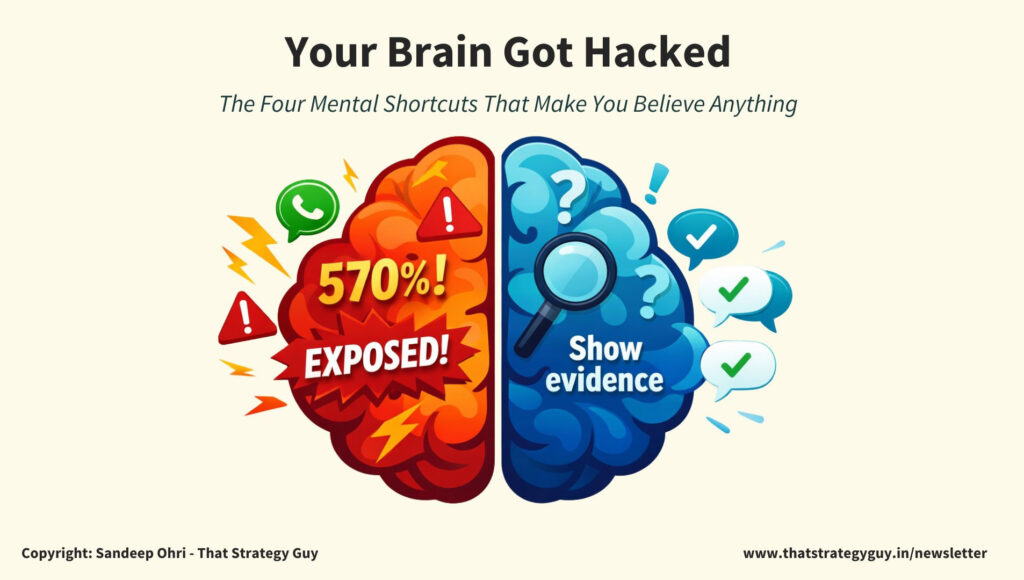
“Indian ‘healthy ice cream’ brands exposed! Lab tests reveal sugar content 570% higher than claimed! GetAWay, Go Zero, Minus Thirty, NOTO – all caught red-handed! Tested at the world’s most reputable labs!”
My first thought: That’s shocking.
My second thought: Show me the lab report.
I asked the person who forwarded it. Silence…
Here’s what’s fascinating: My brain WANTED to believe it. Your brain probably did too. Because this message didn’t just deliver information – it hijacked four specific mental shortcuts that evolution gave us to survive, but which now make us vulnerable to manipulation.
This isn’t about ice cream – it’s about how easily our thinking gets compromised. And more importantly, how to spot it happening.
The Four Cognitive Hijacks
Let me show you exactly how your brain gets played:
Hijack #1: The Precision Illusion
Your brain has a dirty little secret: it mistakes precision for accuracy.
When you see “sugar content 570% higher,” your System 1 thinking (the fast, automatic part of your brain that Daniel Kahneman describes in Thinking, Fast and Slow) goes: Those are specific numbers. Specific = measured. Measured = scientific. Scientific = true.
That’s three mental leaps in under a second. All… WRONG!
Watch how this works: “The product has much more sugar” vs. “The product has 11.4g of sugar instead of the claimed 1.7g.”
The second statement feels exponentially more credible, doesn’t it?
But notice what it doesn’t tell you: Who measured it? How? Which batch? What methodology? What margin of error?
Anyone can type “11.4g.” The decimal point is doing all the heavy lifting.
This is why con artists use oddly specific numbers. “I need £4,347 for the surgery” sounds more genuine than “I need £5,000.” Your brain reads precision as proof. It’s reading the wrong signal.
The hack: Specific numbers should trigger MORE scepticism, not less. They’re a claim, not evidence.
Hijack #2: The Outrage Override
There’s a reason the ice cream message mentions diabetics. And Shark Tank. And “healthy” brands betraying trust.
Because when you trigger moral outrage, rational thinking takes a holiday.
Psychologist Paul Slovic’s research on risk perception shows that perceived moral wrongdoing distorts our ability to assess actual evidence.
We stop asking “Is this true?” and jump straight to “How dare they!”
This is the amygdala hijack. Your emotional brain screams so loudly that your prefrontal cortex (the bit that does critical thinking) can’t hear itself think.
Notice the emotional escalation in these claims:
- Not just “higher sugar” but “570% higher.”
- Not just “misleading” but “frauds.”
- Not just “consumers” but “diabetics deceived.”
Each word cranks up the outrage dial.
Anger is rocket fuel for virality. Nuance and careful verification? They’re speed bumps.
Here’s the test: If you feel ANGRIER than CURIOUS, you’ve been played. Your emotions are doing someone else’s work.
The hack: Moral outrage should trigger the question “Who benefits from my anger?” not immediate forwarding.
Hijack #3: The Authority Costume
“Tested at the world’s most reputable labs.”
Which labs? Oh, you don’t need to know. The phrase sounds authoritative. That’s enough.
This is modern-day alchemy: transmuting vague institutional language into credibility. Your brain has been trained since childhood to respect “authority” – teachers, doctors, scientists. So when someone dresses up in authority language, you unconsciously grant them the benefit of the doubt.
The brands being accused also claim their products are “FSSAI-compliant” and “tested at NABL-accredited labs.” Both sides are waving credentials like duelling pistols.
Here’s what’s happening: You’re being asked to choose which authority to believe based on which one FEELS more trustworthy. That’s not evidence evaluation. That’s fandom.
Real authority can be verified. Fake authority evaporates under questioning. Ask “Which specific lab?” and watch claims crumble or crystallise.
The hack: Authority claims should provoke verification, not submission.
Hijack #4: The Guilt Reversal
This is perhaps the most insidious trick: flipping the burden of proof.
Normally, the ACCUSER must prove guilt. But once a claim goes viral, the ACCUSED must prove innocence.
Notice how the ice cream brands are now on the defensive, issuing statements, citing their own lab results, desperately trying to restore trust?
They’re already guilty in the court of public opinion. Because the accusation reached 12 million eyeballs before they could even respond. And CORRECTIONS never travel as fast as ACCUSATIONS.
This is the presumption of guilt masquerading as “healthy scepticism.” We tell ourselves we’re being vigilant consumers.
Actually, we’re outsourcing our critical thinking to whoever shouts FIRST and LOUDEST.
The 2003 Cadbury worm controversy is instructive here. FDA lab tests confirmed insect infestation – that was real evidence that shifted the burden appropriately. Cadbury had to prove their corrective measures worked. That’s legitimate accountability.
But without verified evidence, viral allegations are just mob justice with a share button.
The hack: Ask “Has guilt been PROVEN or just PROCLAIMED?” before picking up your pitchfork.
When These Mental Hacks Meet Reality
Here’s what’s interesting: Sometimes viral claims turn out to be justified. Sometimes they’re baseless. Often, it’s messy and complicated.
Evidence-based advocacy works: When Maharashtra FDA lab tests confirmed worm infestation in Cadbury chocolates in 2003, that shifted corporate behaviour. When decades of research proved trans fats caused heart disease, governments worldwide banned them. When Johnson & Johnson’s own internal documents (from 1971 onwards) showed they knew about asbestos in baby powder, courts awarded billions to victims.
Evidence-free virality damages legitimate advocacy: The 2015 Maggi scare in India saw initial tests claiming excessive lead levels. The Bombay High Court overturned the ban, finding the testing methodology was flawed. Maggi returned after proper testing. The panic was real. The threat wasn’t.
The difference? Verifiable evidence triggering regulatory/judicial action vs. viral outrage triggering brand defence.
When I helped electricity consumers in Mumbai save thousands of crores fighting Reliance Energy, we didn’t rely on viral forwards. We presented documented evidence to regulatory bodies. That’s how you win.
Viral claims without verification don’t help consumers. They help the next actual problem get dismissed as “another false alarm.”
The Four Questions That Short-Circuit Manipulation
Here’s your mental firewall. When any alarming claim crosses your path – food safety, investment opportunity, political scandal, health warning – run it through these four filters:
Question 1: Can I verify the core claim independently?
Not “does it sound plausible?” Not “did someone credible share it?”
Can I personally verify the foundational claim?
For the ice cream allegations: Where’s the actual lab report? Not a video. Not a screenshot. The actual PDF with methodology, accreditation numbers, batch details, and statistical analysis. If it doesn’t exist or isn’t shared, you have a CLAIM, not EVIDENCE.
This single question eliminates 80% of viral manipulation.
Question 2: Am I feeling or thinking?
Pause. Right now. What’s your dominant response to the claim: emotion or curiosity?
If you’re angry, afraid, or righteously indignant, your amygdala is driving. That’s a feature, not a bug – for the person crafting the message. Outrage spreads. Nuance doesn’t.
The test: Can you explain the counter-argument? Not agree with it – just articulate it fairly. If you can’t, you’re not thinking. You’re reacting.
Question 3: Who benefits from me believing this right now?
Follow the incentive. Viral claims don’t appear spontaneously. Someone launched them. Why?
Sometimes it’s legitimate advocacy. Sometimes it’s a competitor undermining a brand. Sometimes it’s an influencer building an audience. Sometimes it’s just algorithmic chaos where outrage = engagement = revenue.
The question isn’t “is this person evil?” It’s “what does this person gain if I hit forward?” Once you see the incentive structure, manipulation becomes visible.
Question 4: What would I need to see to change my mind?
This is the killer question. The one that separates thinkers from believers.
If you can’t articulate what evidence would make you doubt this claim, you’re not evaluating evidence. You’ve chosen a tribe.
Intellectual honesty demands falsifiability. “What would prove me wrong?” If your answer is “nothing,” you’ve stopped thinking.
Breaking the Barrier
The ice cream allegations might be accurate. They might be nonsense.
Right now, they’re Schrödinger’s scandal – simultaneously true and false until someone opens the box and shows us the actual evidence.
But here’s what I know for certain: Four cognitive hijacks just tried to compromise your thinking.
And now you’ve seen how they work.
- Precision numbers that feel like proof.
- Moral outrage that drowns out questions.
- Authority costumes that demand deference.
- Guilt presumed instead of proven.
These aren’t flaws in the matrix. They’re features of how our brains evolved.
We needed quick pattern-matching to survive sabre-toothed tigers. We didn’t need to fact-check whether the rustling in the grass was definitely a predator or just wind. Better to run first, verify later.
The problem? In the digital age, every day brings a hundred rustling grasses. And running every time exhausts us into either paranoia or apathy.
The solution isn’t to “trust nothing” or “believe experts” or “do your own research.” It’s simpler and harder:
Learn to recognise when your thinking is being hijacked. Then consciously choose to think instead of react.
That’s the barrier we’re breaking: the one between your emotional brain and your rational brain.
Between being someone who consumes claims and someone who evaluates evidence. Between forwarding outrage and demanding verification.
Real change comes from verified evidence presented to regulators, not viral WhatsApp forwards.
And the next “viral claim” is already being typed.
Your cognitive shortcuts are standing by, ready to be exploited.
But you’re NOT standing by anymore.
You know the four hijacks.
You have the four questions.
And you’ve just upgraded your mental immune system.
Well, now you know it too!
What viral claims have made you pause and apply these questions? Hit reply and let me know – I read every response.
